
Working Under Inexperienced Leadership: How Much Is Reasonable to Absorb vs. Escalate?
TL;DR
Managers rarely push back on change because they don’t care, they push back because they’re already overloaded.
What looks like resistance or excuse-making is often a sign that capacity has been exceeded.
Change doesn’t replace a manager’s workload; it stacks on top of it.
Accountability erodes when managers are expected to lead change they haven’t had time or support to process.
Restore capacity first, and accountability often returns without force.
Working Under Inexperienced Leadership: How Much Is Reasonable to Absorb vs. Escalate?
Part of learning is the ability to adapt which comes naturally in absorption; however, when there is no more to learn and your health, your people, and your sanity is at stake, it is time to escalate.
Most Managers Don't Resist Change, they Observe it.
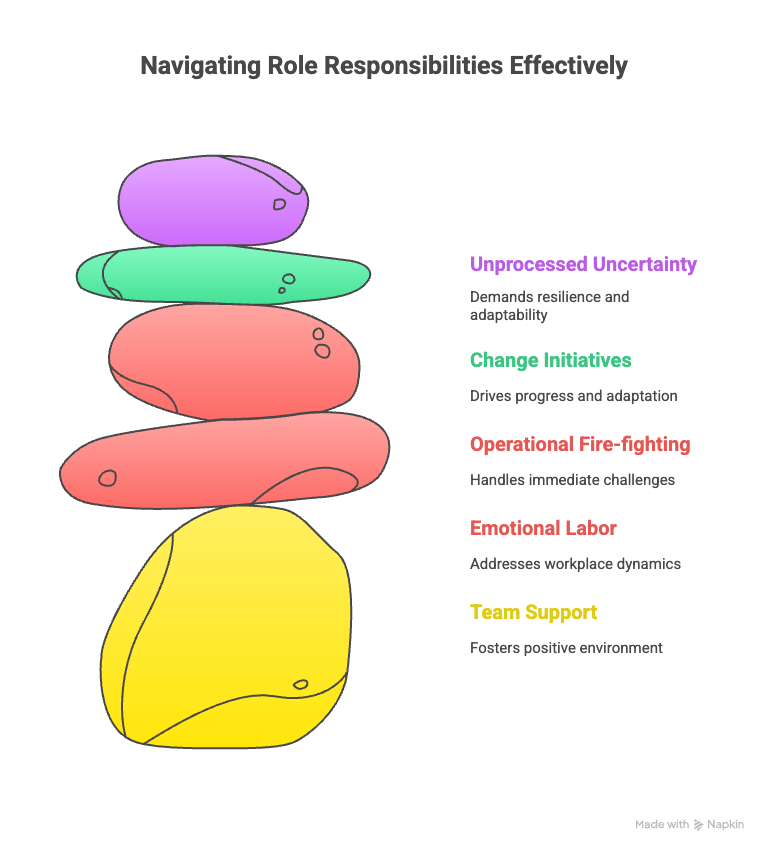
Managers sit in a difficult middle space.
They are not setting strategy, yet they are responsible for outcomes.
They are not immune to uncertainty, yet they are expected to project confidence.
They are not untouched by change, yet they are tasked with leading others through it.
When change arrives, managers don’t experience it once.
They experience it repeatedly.
They absorb it:
From senior leadership, as expectations
From their teams, as fear or frustration
From operations, as disruption
From themselves, as pressure to “get it right”
Change doesn’t replace existing responsibilities.
It layers on top of them.
And over time, that layering creates strain that rarely shows up on dashboards or reports.
What Looks Like Resistance is Often a Capacity Signal
When managers say things like:
“We need more time.”
“The team isn’t ready.”
“This feels rushed.”
“We tried something like this before.”
It’s tempting to hear excuses.
But more often, these statements are signals, not objections.
Signals that:
Cognitive load is already maxed out
Emotional bandwidth is depleted
Risk feels higher than reward
Something important might break if they push forward
A manager who feels steady can move through uncertainty.
A manager who feels depleted will protect whatever stability remains.
That protection is often misread as resistance.
Accountability Breaks When Capacity is Ignored
Accountability is often treated as a character trait, something people either have or don’t.
In reality, accountability is a behavior that depends on conditions.
When managers have clarity, authority, support, and space to think, accountability tends to show up naturally.
When those conditions disappear, accountability doesn’t vanish because the manager stopped caring.
It disappears because the system no longer supports follow-through.
Pressure without capacity doesn’t create accountability.
It creates hesitation, delay, and surface-level compliance.
Why Pressure and Reminders Often Backfire
When change stalls, organizations often respond by tightening control.
More check-ins.
More documentation.
More urgency.
The intention is understandable.
But for managers already operating at capacity, pressure doesn’t motivate, it actually constricts.
Under sustained pressure:
Decision-making slows
Risk tolerance drops
Communication becomes cautious
Initiative fades
Managers stop leading forward and start managing exposure.
From the outside, it looks like disengagement.
From the inside, it’s self-preservation.
Change Management Fails When Managers Haven't Proccesed the Change Themselves
Managers are human before they are leaders.
Yet they are often expected to:
Communicate change immediately
Model confidence publicly
Answer questions they’re still wrestling with
All before they’ve had time to understand:
How this change affects their role
What trade-offs it requires
What risks they’ll be accountable for
You cannot ask someone to steady others while they are still finding their own footing.
When managers hesitate, it’s not defiance.
It’s instinct.
A Necessary Truth: Sometimes It's Not Capacity...It's Performance
Not every manager who resists change is overwhelmed.
Some managers genuinely aren't doing the work.
There are managers who:
Avoid responsibility consistently
Deflect feedback instead of acting on it
Hide behind excuses even when support is available
Resist change as a pattern, not a moment
And in those cases, the issue is not capacity.
It’s performance, readiness, or fit for the role.
Recognizing capacity collapse does not mean excusing chronic avoidance.
How to Tell The Difference
Overloaded managers tend to:

Want to do the work but feel stuck
Show effort without consistent follow-through
Engage when support and clarity increase
Improve when pressure is reduced and expectations are clear
Underperforming managers tend to:
Avoid action even after capacity is restored
Resist feedback repeatedly
Deflect responsibility rather than own impact
Show consistent patterns of avoidance
Capacity issues fluctuate.
Performance issues persist.
Leadership requires discernment, not blanket explanations.
Holding Both Truths at Once
Strong organizations hold two truths simultaneously:
Some managers are overwhelmed and need support to lead well again.
Some managers are not doing the work and must be held accountable.
When capacity is restored, and performance expectations are clear, accountability becomes meaningful, not reactive.
Anything less becomes either cruelty or permissiveness.
Neither builds strong leadership.
The Leadership Shift That Makes Changes Stick
If organizations want managers who:
Own change
Lead decisively
Follow through consistently
They must stop asking:
“Why won’t they step up?”
And start asking:
“What does this manager need to lead this well, and are they willing to do the work?”
Because leadership doesn’t fail from lack of skill.
It fails when capacity collapses, or when accountability is avoided.
Before your next change initiative, ask yourself:
Are we asking managers to carry change without restoring the capacity, or confronting the performance, required to lead it?
The answer will tell you whether change will stick… or stall again.
♻️ If this helped you see manager resistance differently, share it so someone else can lead with more clarity.
Want clarity on what’s really draining your resilience?
👉 Take the THE MANAGER RESILIENCE SCORECARD™ and discover your hidden load.


