
Every manager has a Reactor Pattern. Most have never been shown theirs.
The Reactor Pattern is the automatic behavioral response that fires when the pressure hits, before you can consciously choose differently. It has a formula. It has a name. And once you see it, you cannot unsee it.
What is the Reactor Pattern?
The Reactor Pattern is a proprietary behavioral framework developed by Nagham Alsamari through Imkan Leadership Development. It describes the specific sequence of events that happens inside a manager when pressure triggers an automatic behavioral response.
Most leadership training focuses on what managers should do differently. The Reactor Pattern framework starts one level deeper, with why managers do what they do before any conscious skill can be applied.
Every person has a dominant behavioral style. Under normal conditions that style is a strength. Under pressure that same style intensifies into an automatic response, one that provides short-term relief but carries a hidden cost. That response is the Reactor Pattern.
The Reactor Pattern is not a personality flaw. It is a behavioral sequence that runs automatically until it is named, understood, and deliberately interrupted.

Join Our Next Event By
Imkan Leadership Development
The Reactor Pattern formula
Every Reactor Pattern follows the same four-step sequence. The details are unique to each person. The structure is universal.
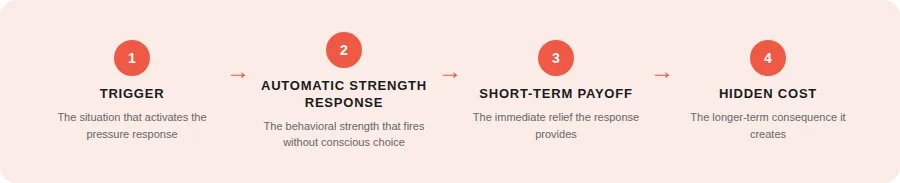
Trigger
A specific situation, person, or event that activates the pressure response. Not all situations trigger the pattern equally. Each behavioral style has its own primary triggers.
Automatic Strength Response
The behavioral strength that fires automatically in response to the trigger. High D becomes more decisive and controlling. High I becomes more expressive and avoidant. High S becomes more accommodating and passive. High C becomes more analytical and withdrawn. The response is not a weakness. It is a strength running unchecked.
Short-Term Payoff
The immediate relief the automatic response provides. This is why the pattern keeps firing. It works in the short term. The payoff is real. The urgency feels resolved. The discomfort is temporarily reduced.
Hidden Cost
The longer-term consequence the automatic response creates. Eroded trust. Avoided conversations. Decisions made too fast or not at all. Team members who stop bringing problems. This is the cost most managers are paying without knowing why.
Most managers are paying the hidden cost of their Reactor Pattern every single week. They just don't have a name for it yet.
Find your Reactor Pattern
The formula is simple. The insight it produces is not.
When happens,
I tend to
because .
It helps me ,
but it costs me .
Fill in those five blanks honestly and you have named your Reactor Pattern. Most managers who do this exercise for the first time say the same thing: nobody has ever shown them this before. Not in 10 years of management. Not in any training they have attended. Not in any book they have read.
That recognition, that moment of seeing the pattern clearly for the first time, is where the work begins.
Why the Reactor Pattern matters for managers.
It explains what training didn't
Most managers have attended resilience workshops, communication trainings, and leadership programs. The patterns are still there. That is because most training teaches what to do. The Reactor Pattern framework explains why you do what you do. That distinction changes everything.
It is behavioral, not motivational
The Reactor Pattern is not about mindset or attitude. It is a behavioral sequence rooted in your DISC style. That means it can be identified precisely, mapped to real situations, and interrupted with a specific behavioral tool. Not willpower. Not positive thinking.
It is the foundation of everything else
You cannot build a different response to pressure until you understand the automatic one. The Reactor Pattern is the starting point for Nagham's Behavioral Resilience Training™ and the reason the training works where others have not.
We asked 80 managers and leaders: "What does pressure feel like in your body right now?"
Not stressed. Not anxious. Physical.
Your body knows your Reactor Pattern is firing before your brain does. That is why knowing what to do differently is not enough. You have to interrupt the pattern at the source. That is what the Reactor Pattern framework is built to do.
Data collected across Leadership Oakland, Compass Detroit, and Inner Goddess Collective using live Mentimeter responses from 80 participants.
How to identify your Reactor Pattern
Your Reactor Pattern is rooted in your DISC behavioral style. Start with the free Personality Profile to see your one-letter result and key patterns under pressure.
Start here: Take the free Personality Profile
The free Personality Profile gives you your one-letter DISC result (D, I, S, or C) and shows you your key strengths and blind spots under pressure. It takes five minutes. It is the starting point for understanding how you show up when the pressure spikes.
Take the free Personality Profile
Want the full breakdown?
The full DISC Assessment and 60-minute debrief with Nagham gives you your complete behavioral profile and maps it directly to your Reactor Pattern. You leave the session knowing exactly what your pattern is, why it fires, and what to do differently.
Get the full DISC Assessment, Report, & Debrief
Questions about the Reactor Pattern?
Who developed the Reactor Pattern framework?
The Reactor Pattern was developed by Nagham Alsamari, founder of Imkan Leadership Development, through 13 years of training managers, teachers, and leaders across sectors. It is the diagnostic framework underneath all of Nagham's Behavioral Resilience Training.
Is the Reactor Pattern the same as my personality type?
No. Your personality type (your DISC style) is stable. It describes how you prefer to behave. Your Reactor Pattern is what happens under pressure when that preference gets triggered automatically. The personality type is the foundation. The Reactor Pattern is the automatic response built on top of it.
Can the Reactor Pattern be changed?
Yes, but not by ignoring it or trying to suppress it. The Reactor Pattern changes when you interrupt the automatic sequence with a different behavioral response. That interruption requires awareness, a specific tool, and repetition. That is what Behavioral Resilience Training teaches.
How is the Reactor Pattern connected to DISC?
The Reactor Pattern is rooted in Maxwell DISC behavioral science. Each DISC style (D, I, S, and C) has a specific automatic response under pressure. The full DISC Assessment and debrief with Nagham maps your style directly to your specific pattern.
How is the Reactor Pattern different from reactive leadership?
Reactive leadership is a broad concept. The Reactor Pattern is a specific named framework with a four-step formula: Trigger, Automatic Strength Response, Short-Term Payoff, Hidden Cost. It gives managers a precise behavioral map rather than a general concept.
How does knowing my Reactor Pattern help me?
Knowing your Reactor Pattern gives you the ability to see the automatic response before it fires. Most managers feel the trigger, react, and then analyze what happened after the damage is done. When you know your pattern, you can catch it in real time and choose a different response. That gap between trigger and reaction is where resilience gets built.