
Stop Making New Hires Feel Like a Burden: A Small-Team Onboarding Reset
TL;DR
Early exits often happen when new hires feel unsafe to ask for help.
Watch for the “burden signal”: missing access, unclear expectations, rushed handoffs, and visible frustration.
Fix it with a lightweight system: access first, a buddy, and a tiny first win.
Schedule daily question time and build a simple coaching/feedback loop.
You don’t need HR, you need clear ownership.
Why do new hires quit so fast on small teams?
Short answer: When a new hire leaves early, it’s often not about the work, it’s about how safe it feels to ask for help.
You can lose a great new hire in a matter of weeks… without ever raising your voice.
It happens in small teams all the time.
Not because the person can’t do the job.
But because every moment of “I need help” starts to feel like they’re inconveniencing the team.
And once a new hire feels like a burden, the exit is already in motion.
Maybe you relate to this:
You’re busy, juggling meetings, clients, and fires.
You assume a smart new hire will “figure it out.”
You tell them to shadow someone… and then forget to check if anyone actually has time.
Access isn’t ready, tools aren’t set up, and they spend days waiting.
When you finally hand off a task, you explain fast and run.
The first mistake happens, and your frustration shows.
None of this makes you a bad person.
But it does create a message the new hire can feel in their body:
“Every question costs the team something.”
And that’s the message that makes people quit.
The hidden reason new hires leave small teams
Big companies can hide onboarding mistakes behind layers of structure.
Small teams can’t.
When you’re 10-20 people, onboarding isn’t a “program.” It’s a lived experience, created by whoever is nearest to the new person.
So new hires aren’t just evaluating the job. They’re evaluating:
Is it safe to ask questions?
Do people have time for me?
Do I have what I need to succeed?
When I mess up, will I be coached… or judged?
If the answer is “I’m slowing everyone down,” they’ll self-select out, especially early-career hires who are already anxious about proving themselves.
The “burden signal” (and how it shows up)
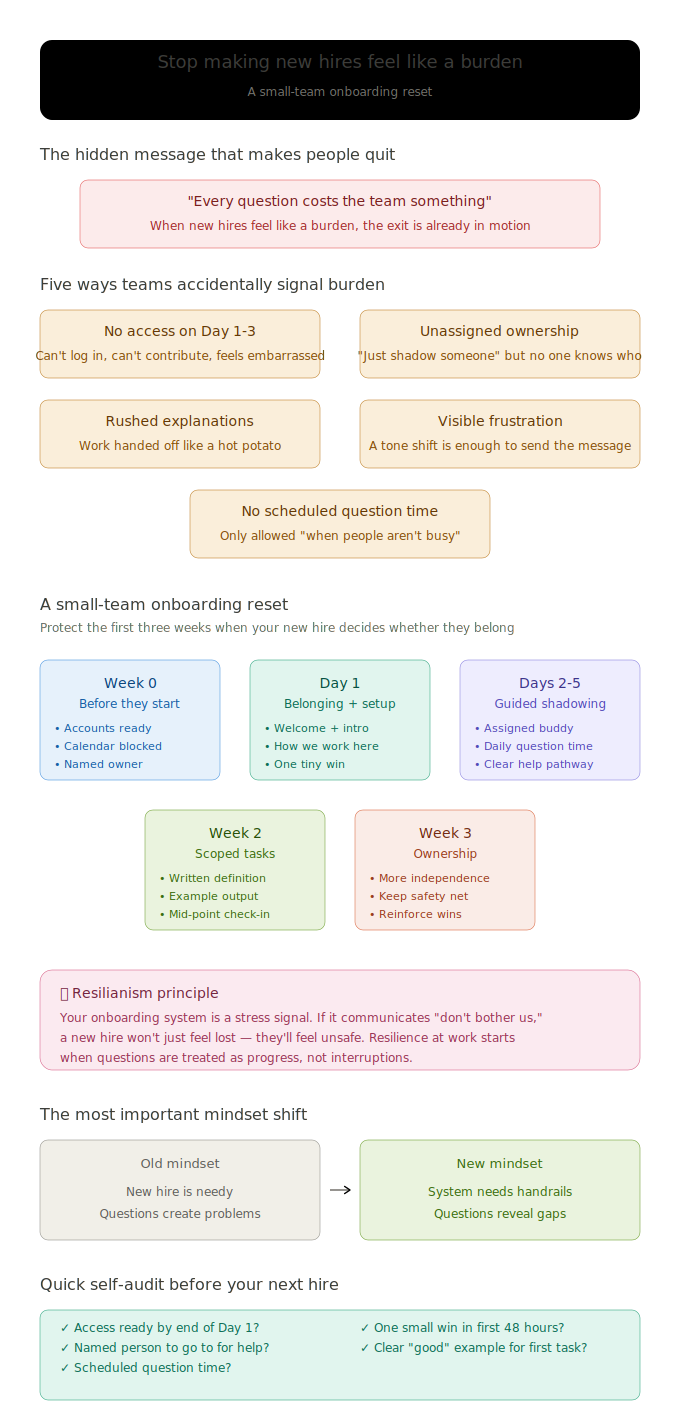
Here are the most common ways teams accidentally tell a new hire they’re a burden:
No access on Day 1-3
If someone can’t log in, they can’t contribute, and they’ll start feeling embarrassed asking again and again.
Unassigned ownership
“Just shadow someone” sounds reasonable until no one knows they’re responsible.
Rushed explanations + rushed handoffs
When work is handed off like a hot potato, the new hire learns: “I should not ask follow-up questions.”
Visible frustration at normal mistakes
You don’t have to yell. A tone shift is enough.
No scheduled time for questions
If questions are only allowed “when people aren’t busy,” they’re basically not allowed.
You can't fix this with more motivation. You need a system that runs this in the background.
A small-team onboarding reset (that doesn’t require HR)
You don’t need a fancy onboarding department.
You need a lightweight plan that protects the first three weeks — because that’s when your new hire is deciding whether they belong.
Here’s a simple structure that works for teams of ~15.
Week 0 (before they start): remove friction
Accounts + permissions ready (email, Slack, project tools, documentation access)
Laptop/setup checklist complete
First-week calendar blocked with key meetings + shadow sessions
A named onboarding owner (yes, one person)
If you want a lightweight, manager-friendly onboarding structure you can actually run (without HR), start inside Imkan Academy - this is where I teach the systems that make questions feel safe again.
Day 1: belonging + setup (no “real work”)
Welcome + introductions (make it explicit)
“How we work here” overview: communication norms, where decisions live, how to ask for help
Confirm access works live (don’t assume)
Give them a tiny win: a low-stakes task that proves they’re useful
Days 2-5: guided shadowing + predictable question time
Assign a buddy (not just “someone”)
2 shadow blocks per day (even 30 minutes is fine)
Put ‘Question Time’ on the calendar (15–30 minutes daily)
One document that answers: “What should I do if I’m stuck?”
If you want a fast diagnostic for what’s breaking trust and safety on your team right now, take the free Manager Resilience Scorecard™ - it will show you what pressure patterns are leaking into your leadership (including onboarding).
Week 2: scoped tasks + coaching loop
Give one task with:
a written definition of “done”
an example of a good output
a check-in point before the final deliverable
When mistakes happen, treat them like data:
“What assumption did we leave unclear?”
“What access or context was missing?”
Week 3: ownership + confidence
Increase independence, but keep the safety net:
fewer check-ins, still scheduled
reinforce what they’re doing well
ask what’s confusing even if they think it’s ‘a dumb question’
If you want support implementing this as a simple operating system (not a document), book a conversation with me here
The most important mindset shift
The biggest change isn’t the checklist.
It’s admitting this:
If onboarding feels heavy, it’s not because the new hire is needy.
It’s because the team has been relying on unspoken knowledge — and now someone new is revealing the gaps.
That’s not a threat.
That’s a gift.
When a new hire asks a question, they’re not creating a problem.
They’re showing you where your system needs a handrail.
A quick self-audit (for the next person you hire)
Before the next hire starts, ask:
Do they have access to everything by end of Day 1?
Can they name exactly who to go to for help?
Is there scheduled question time?
Do they have one small win in the first 48 hours?
Do we know what “good” looks like for their first task?
If you’re a manager or team lead and new hires keep leaving fast, don’t only ask whether they’re a fit.
Ask whether your onboarding experience is quietly telling them:
“You’re a burden here.”
And then build a first-week plan that says the opposite.
Because talent doesn’t leave when work is hard.
Talent leaves when it feels unsafe to be new.
Final Thought
Early exits aren’t usually a “new hire problem.” They’re an environment problem, especially on small teams where every question feels public. The fastest fix isn’t more training. It’s a system that makes asking for help predictable and safe.
Start with one shift: schedule question time like it’s a deliverable. Then watch what changes in confidence, speed, and trust.
What about you? What’s one part of onboarding on your team that consistently breaks down, access, unclear ownership, or the fear of asking “basic” questions? Drop it in the comments. I read every one.
Feeling the Pressure? Start Here.
If you're navigating a high-stakes leadership moment, whether it's bad survey results, a potential PIP, or just the daily weight of leading through instability, you need to know where your resilience stands.
Take the free Manager Resilience Scorecard™ to assess yourself across the 5 pillars of resilient leadership. You'll get a personalized score and clear next steps to lead through pressure without losing yourself in the process.
It takes 3 minutes. And right now, clarity might be the most valuable thing you can give yourself.


